
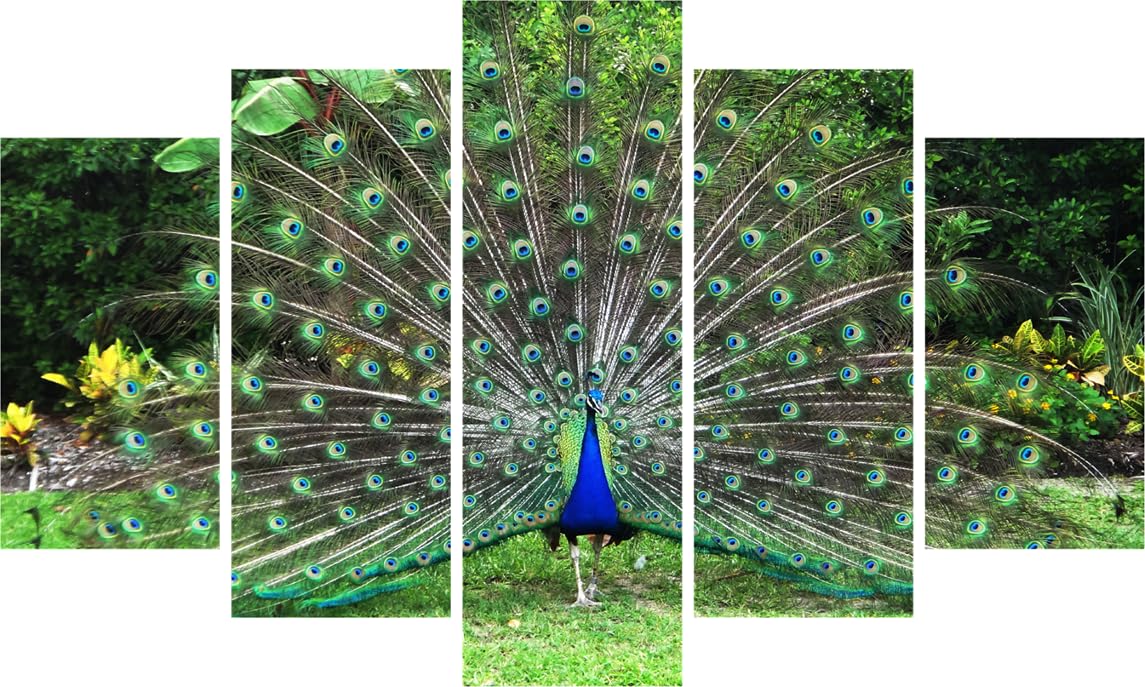
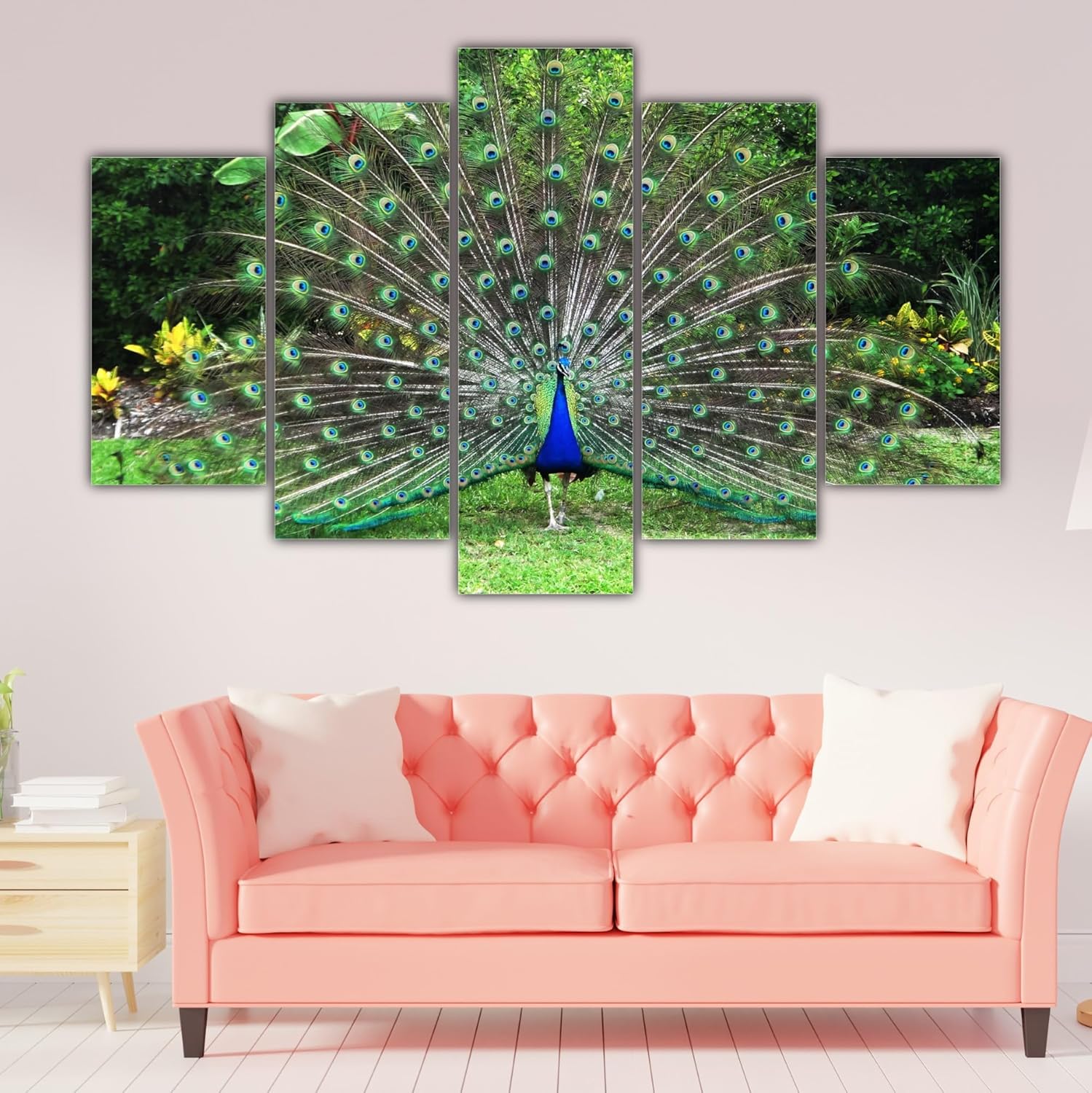
Peacock-tastic Framed Vinyl Wall Art Feathered Fiesta in 5 Panels
You may also like


Moolwan 5-Panel Peacock Canvas Wall Art Painting (127x76cm) - Feathered Majesty Multi-Frame Nature Art
You keep opening the product page, trying to mentally place this on your living room wall. But it's impossible to know for sure, isn't it? 127cm looks perfect in mockups, but your wall has windows on one side and maybe a console table below. You need to know this works in your specific space, not just styled photos.
Here's what actually happens when you mount 127cm peacock wall art on a 12-foot wall: the canvas takes up about 35% of your wall width. That leaves 116cm of breathing room on each side—enough space that the peacock doesn't feel cramped, but not so much that it looks lost. Your sofa is probably 6-8 feet wide. The canvas sits comfortably above it without extending past the armrests or looking undersized.
The yellow background isn't random decorator preference. In Indian living rooms with cream or off-white walls, yellow creates warmth without overwhelming the space. The blue-green peacock feathers provide contrast against neutral furniture—your brown sofa, wooden coffee table, or beige curtains. This isn't about perfect color matching. It's about colors that work together without demanding you repaint walls or replace cushions.
Why 127cm Works on 12-Foot Walls (and What Happens If You Go Smaller or Bigger)
Your wall is probably 360cm wide (12 feet). A 127cm canvas covers 35% of that width. The math shows 233cm of uncovered wall space, split roughly even on both sides.
If you went smaller to 100cm: You'd have 27% wall coverage. That extra 130cm on each side starts making the canvas feel decorative rather than intentional. From your sofa 8-10 feet away, it might read as "nice but small."
If you went larger to 150cm: You'd have 42% wall coverage. Only 105cm on each side. Still balanced, but less flexibility if you have wall switches, photo frames, or a tall plant in one corner.
The 5-panel design changes the visual math. Instead of one solid 127cm block, your eye sees five separate frames with gaps between them. This makes the total width feel more expansive than a single-frame canvas of the same size. The peacock's spread feathers naturally extend across panels, creating movement that fills more visual space than the measurements suggest.
Most Indian living rooms are 12x14 feet with 8-10 foot ceilings. The 76cm height works because it doesn't compete with ceiling height—it stays in the middle third of your wall, leaving space above for breathing room and below for furniture. You're not trying to fill floor-to-ceiling. You're creating a focal point at eye level when standing, slightly above eye level when seated.
Why Blue-Green Peacock with Yellow Background Works in Indian Living Rooms (Not Just Online Photos)
Your walls are probably cream, off-white, or light yellow—the standard builder's palette in Indian apartments. Yellow-toned art doesn't fight cream walls. It complements them. The blue peacock provides the contrast your eye needs without clashing.
Here's what you're actually seeing: The yellow background picks up undertones in wooden furniture. If you have a teak console, mango wood bookshelf, or even laminate TV unit with wood grain, the yellows create visual continuity. The blue peacock keeps things from reading as "all warm tones"—it adds coolness without needing actual blue furniture.
The green in the peacock feathers bridges yellow and blue. In Indian homes with plants—money plants on shelves, tulsi in the balcony visible through doors, potted palms near windows—the green in the art connects to those natural elements. You're not matching colors perfectly. You're creating a palette that feels cohesive with what's already there.
Your living room lighting probably shifts throughout the day. Morning sunlight through east-facing windows makes the yellow glow warmer. Evening LED tube lights (standard in most homes) bring out the cooler blues and greens in the peacock. The art doesn't look like a completely different piece depending on time of day—it just emphasizes different aspects of the same palette.
The peacock itself carries cultural familiarity in Indian homes without being explicitly religious. If you have traditional elements—a small Ganesh statue, brass diyas, or a pooja shelf—the peacock doesn't clash. If your space is more contemporary, the nature theme still works. It's neutral enough to coexist with different decorating approaches.
Installation Takes 15 Minutes (Even If You're Not Handy)
The 5 panels arrive pre-framed. You're not stretching canvas or building frames. Each panel weighs about 600 grams—light enough to hold with one hand while marking wall positions.
You'll need: measuring tape, pencil, hammer, 10 nails (included). The process is marking five positions across your wall at the same height, hammering nails, and hanging panels. The panels have keyhole slots on the back—you're sliding them onto nails, not drilling complex mounting systems.
The rental deposit concern is valid. You're looking at 10 nail holes total, each about 2mm wide. Filling them when you move takes 30 minutes with wall putty from any hardware store (₹50 per pack). This isn't like mounting a TV bracket with visible bolts. It's standard picture-hanging that every tenant does.
The splash-proof vinyl coating matters if you're hanging this near windows that let in monsoon spray, or in rooms where ceiling leaks sometimes happen during heavy rain. The coating won't save the art from direct water damage, but it handles humidity and occasional splashes better than paper-based prints.
Each panel is 0.6cm thin. From the side, they're barely visible. The focus stays on the artwork, not chunky frames protruding from your wall. When you're watching TV or talking to guests, peripheral vision registers a flat installation, not something jutting into the room.
How This Compares to Other Sizes You've Been Considering
The 100cm version of similar peacock art gives you 28% wall coverage on a 12-foot wall. That's 130cm of empty space on each side. It works above a study desk or in a bedroom above a dresser. For a main living room wall above an 8-foot sofa, it starts feeling undersized.
The 150cm version gives 42% wall coverage. That's 105cm on each side—still balanced, but less forgiving if you have architectural quirks. A wall switch 50cm from the edge, a door frame on one side, or a tall bookshelf in the corner means less flexibility in centering the art.
At 127cm, you're in the middle ground that handles most real-world living rooms. Enough space on the sides to accommodate furniture arrangements, light switches, or decor without looking cramped. Large enough to feel intentional from across the room, not like you bought the smaller size to save ₹500.
The 5-panel format versus single-panel matters more than size sometimes. A single 127cm frame reads as one solid block. Five panels create visual rhythm—your eye moves across the spread peacock feathers instead of landing on one static image. Guests notice the multi-panel composition before they consciously register the size.
Marketplace canvas at ₹800-1200 typically uses 240 GSM paper-based prints with basic pine frames. They're lighter (easier to ship cheaply), but they warp in humidity within 6-12 months in Indian climates. The vinyl material here and kiln-dried pinewood frames handle 70-85% monsoon humidity without warping or peeling.
What This Will Look Like in Your Living Room (Not Just Online Photos)
From your sofa 8-10 feet away, the peacock's spread tail feathers read clearly. You can distinguish individual feather details in the blue-green plumage. The 5-panel separation creates depth—your eye sees layers, not a flat image. This matters because online photos compress depth perception.
If your living room has standard tube light (white LED), the blue peacock feathers appear more vibrant in the evening. Morning sunlight through windows (if you have east-facing exposure) warms the yellow background and softens the blue tones. Neither lighting condition makes the art look "wrong"—they're just different aspects of the same piece.
The yellow background isn't neon or mustard. It's closer to soft marigold or afternoon sunlight. Against cream walls, it creates subtle contrast without demanding attention. The peacock itself is the focal point—the yellow serves as backdrop that makes the bird stand out.
Your ceiling is probably 8-10 feet high (standard in Indian apartments built after 2000). Mounting this 76cm tall canvas with its top edge at 7 feet leaves appropriate space above for the ceiling to breathe. The bottom edge sits around 4.5 feet—above most furniture, at comfortable viewing height when seated.
Wall texture matters. If you have textured paint (common in builder homes), the canvas smoothness creates contrast. If you have flat paint, the artwork adds dimension to an otherwise uniform surface. Either way, you're not covering texture with more texture—you're adding a visual element that breaks up wall monotony.
The peacock faces center in the middle panel. When you enter the room, your eye naturally goes to that central bird, then explores outward to the spread tail feathers on side panels. This center-weighted composition works for living room entries where you're typically entering from one side, not straight-on.
Quick Specifications
- Product Name: Moolwan 5-Panel Peacock Canvas Wall Art Painting
- Dimensions: 127cm (W) x 76cm (H) x 0.6cm (D)
- Weight: 3 kg (600g per panel approximately)
- Material: Splash-proof vinyl on 340 GSM canvas
- Frame: 1.5" kiln-dried pinewood (12% moisture content)
- Panel Count: 5 panels (multi-frame design)
- Colors: Blue, green, yellow
- Subject: Peacock with spread feathers (nature/wildlife)
- Wall Coverage: ~35% on 12-foot walls
- Best For: Living rooms, bedrooms, offices with 12-14 foot walls
- Installation: 10 nails included, keyhole mounting slots
- Care: Wipe with dry cloth, splash-resistant (not waterproof)
- Price: ₹3,496
- Delivery: 5-6 days in metro cities, 6-8 days in tier-2/3 cities
- Suitable For: Indian homes with cream/off-white walls, wooden furniture
- Climate: Handles 70-85% humidity, 5°C-45°C temperature range